I Spent Way Too Much Making My Home “Quiet Luxury.” Here's What Was Actually Worth It
The homes that restore us look different from the homes we think we want when we're scrolling through Instagram at 11 p.m. The homes we pin and save tend toward drama. The homes that actually make us feel better when we walk through the door tend to be quieter than that. More considered. Less performative.
The Nervous System Is Your Real Client
Your nervous system responds to your environment whether or not you're consciously aware of it. Visual clutter activates threat-detection. Harsh lighting suppresses melatonin and elevates cortisol at hours when both should be dropping. Your home is either working with your biology or against it, regardless of how pretty it looks in photos.
The Changes Worth Making First
Lighting before anything else
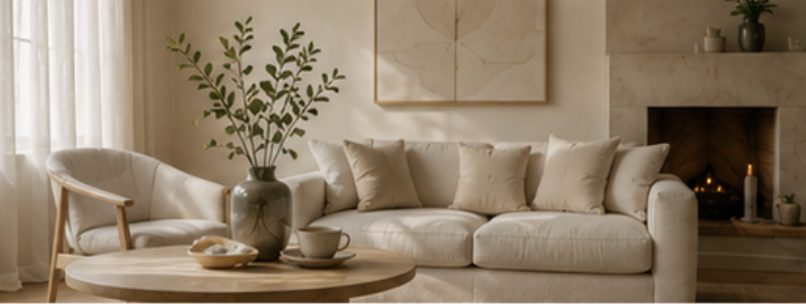
No single change has a higher return on investment in residential interiors than switching from overhead fluorescent lighting to warm, layered light sources at lower heights. Lamps. Sconces. Dimmers on every overhead fixture. The goal is light that mimics late-afternoon sun in the evening hours. Rooms lit this way feel instantly more calming and more beautiful. It costs less than a sofa and transforms a space more than almost anything else.
Texture over pattern
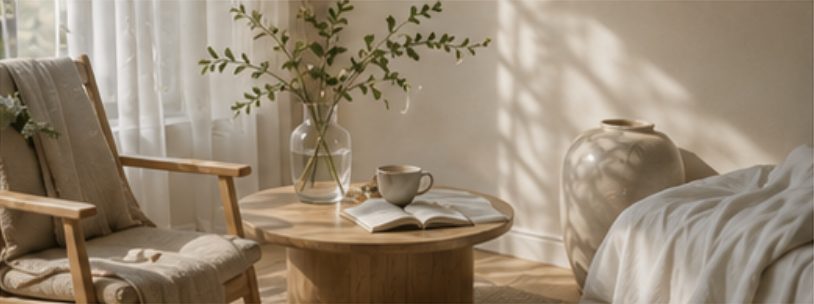
The homes that feel most restorative tend to be rich in texture and restrained in pattern. Linen, wool, stone, aged wood — materials that have warmth and variation without visual busyness. A patterned sofa in a small room competes for attention constantly, even when you're not looking at it. A linen sofa in a warm neutral reads as a place to land.
The case for negative space
American homes tend to be overfurnished and over-accessorized. The homes that feel most luxurious tend to have been edited down. Things removed rather than added.
"The most restorative room is not the most decorated one. It's the one where everything in it has a reason to be there."
The One Room Worth Getting Right First
If you are going to invest in making one room a genuine sanctuary, make it your bedroom. This is the room where your body does its most important work: rest, recovery, the hormonal reset that makes everything else function. It should be the coolest room in the house at night. The darkest. The quietest. And it should feel, when you walk into it, like a place you have been gently expected.
Before you can design the sanctuary, you have to close on the house — our guide to the questions every smart woman asks her realtor is worth reading first.
The Uncomfortable Truth Behind "Quiet Luxury" as a Design Trend
Here's what's rarely said plainly: "quiet luxury" interiors, for all their calming aesthetic, are frequently not actually quiet in cost. The linen, the specific shade of white paint, the custom millwork — these are often more expensive than the maximalist styles they've replaced, precisely because restraint at this level of execution requires exceptional materials and craftsmanship to avoid looking simply empty or unfinished. The aesthetic reads as effortless. The budget behind it, for most homes achieving it fully, is not.
This is worth naming honestly, because the actual, physiologically-grounded principles underneath quiet luxury — better lighting, reduced visual clutter, natural materials — are achievable at almost any budget. The specific aesthetic packaging of "quiet luxury" is not required to get the nervous-system benefits this piece is actually about.
The Provocative Part: Minimalism Can Become Its Own Kind of Anxiety
An overcorrection is happening in some homes pursuing this aesthetic — a low-grade anxiety about visual clutter that starts to feel less like calm and more like a new, exhausting standard to maintain. A home so edited that a child's artwork or a stack of library books feels like a violation of the aesthetic isn't actually calming. It's swapped one performance for another, dressed in beige instead of color.
"A home that requires constant vigilance to stay 'calm looking' has simply replaced one kind of tension with another, better-lit one."
What the Research Actually Supports, Separate From the Aesthetic
Warm, layered lighting
This is the genuinely evidence-backed piece, unrelated to any specific style. Warm light in the evening hours supports melatonin production and signals to your nervous system that the day is winding down — true whether your home is minimalist, maximalist, or anything in between.
A defined "off" space, somewhere
One room, or even one corner, genuinely free of screens and work materials, gives your nervous system a reliable cue for rest that a fully open-plan, everywhere-is-everything home doesn't provide as clearly.
Texture over minimalism, specifically
The calming effect attributed to "quiet luxury" interiors is driven substantially by texture — linen, wool, worn wood — not by the absence of color or pattern. A colorful home with rich, natural textures can be just as nervous-system-calming as a beige one, a detail the aesthetic trend tends to obscure.
A More Honest Version of This Advice
Skip the specific palette if it's not you. Chase the underlying principles instead: warm light, natural texture, one genuinely restful room, and an honest edit of what you don't actually use. That will do more for how your home feels than matching a specific aesthetic ever will, and it costs considerably less.
What Environmental Psychologists Actually Study Here
The academic field studying how physical space affects mood and nervous system regulation is more specific than the popular "quiet luxury" aesthetic suggests. The consistent findings center on light quality, ceiling height relative to room size, and the presence of natural materials and greenery — not on any particular color palette or minimalist philosophy. A home can follow every principle this research supports while looking nothing like the beige aesthetic currently associated with the term.
A Reflection on What Your Home Is Actually Communicating
Before the next renovation or redesign decision, it's worth asking: is this change actually serving how my nervous system functions in this space, or is it serving how the space will look in photographs? These two goals occasionally align and often don't, and a home optimized primarily for how it photographs can end up quietly working against the calm it was meant to represent.
A Closing Word on Building a Home That Serves You, Not an Audience
The ultimate test of any design choice in your home isn't how it performs in a photograph. It's how your body and nervous system respond to it at 9pm on an ordinary Tuesday, with no one watching and nothing to prove. A home built around that quieter, unphotographed standard will serve you for decades. One built around how it looks to visitors rarely does, once the initial impressiveness wears off for the people actually living inside it every day.