The Case for Dressing Like You Have Somewhere to Be (Even When You Don't)
Somewhere in the last decade, a quiet agreement was reached without anyone voting on it: trying too hard became embarrassing, and not trying at all became a kind of virtue. Athleisure stopped being what you wore to the gym and became what you wore to the grocery store, the school pickup line, the client call, the first date. Comfort was rebranded as authenticity. And a whole generation of women, myself included for a while, decided that the safest way to be taken seriously was to look like we hadn't spent a single second thinking about how we looked.
I want to gently suggest that we got this wrong. Not wrong in the sense that leggings are bad, or that comfort doesn't matter. Wrong in the deeper sense — that we mistook effortlessness for freedom, when for a lot of us it was actually a form of hiding.
The Quiet Tyranny of "I Didn't Try"
Here is the thing nobody says out loud: dressing like you don't care is its own kind of performance. It says something, whether you intend it to or not. It says I've opted out. It says this isn't a room worth showing up for. Sometimes that's exactly the message you want to send, and there's nothing wrong with a Sunday in sweatpants. But somewhere along the way, the sweatpants stopped being the exception and became the default setting for an entire era of women's lives — including the parts of our lives that actually mattered to us.
I think about the women I know who dress with real intention — not extravagantly, not expensively, just on purpose — and the thing they have in common isn't money. It's that they've decided their presence in a room is worth a small amount of effort. There's a kind of self-respect embedded in that decision that has nothing to do with vanity and everything to do with how seriously you take your own life.
"Getting dressed on purpose is one of the last remaining ways to tell your own day that you expect something of it."
What "Dressing with Intention" Actually Means
To be clear, this isn't a call to abandon comfort or to perform womanhood for an audience that isn't there. It's something quieter and, I'd argue, more radical: treating the act of getting dressed as a small daily decision about how you intend to move through the world, rather than a chore to be minimized.
It's not about the clothes being expensive
Some of the most intentionally dressed women I know shop almost entirely secondhand. The intention isn't in the price tag. It's in the fact that they know what they're putting on and why — the silhouette that makes them stand up straighter, the color that makes their eyes look alive, the fabric that feels like a decision rather than a default.
It's not about performing for other people
This is the part that trips people up. The instinct is to assume that caring about your appearance means caring what other people think of you. In practice, the opposite tends to be true. The women who dress with the most quiet confidence are usually dressing for an audience of one — the version of themselves they're trying to become. It has almost nothing to do with anyone else in the room.
It's a discipline, not a talent
You do not need to have "an eye for style" to do this well. You need three or four outfits that work, that you understand, and that you can put on without a decision fatigue spiral at 7am. Simplicity, repeated consistently and with intention, reads as far more put-together than an enormous closet used carelessly.
The Provocative Part: Athleisure Culture Might Have Cost Us More Than We Realize
Here's where I'll say the quiet part out loud. I think the athleisure-everywhere era, for all its comfort, quietly trained a lot of women to disappear a little. Not dramatically. Just incrementally — a slow erosion of the small daily ritual of deciding who you were going to be that day. And rituals matter more than we give them credit for. The way you dress in the morning is one of the very few moments in a day when you get to make a decision entirely for yourself, before the demands of children, work, and everyone else's needs arrive.
When that decision gets outsourced to "whatever's clean and stretchy," something subtle is lost. Not your worth — nothing about your value as a person changes based on what you're wearing. But a small daily act of authorship over your own life quietly goes missing, and most of us didn't notice it leaving.
What This Looks Like in Practice
Build a uniform, not a wardrobe
The chicest women you know are not reinventing themselves every morning. They've found two or three formulas — the tailored trouser and the good blouse, the midi skirt and the fitted sweater — and they repeat them with high-quality basics. This isn't laziness. It's editing, and editing is a sign of taste, not its absence.
Dress one notch above the occasion
Not for the school run in heels and a cocktail dress. Just one small notch above the bare minimum the occasion requires. If everyone else is in a t-shirt, you're in a nice t-shirt and real trousers. It's a small gap, but it's a gap that people feel even if they can't articulate why.
Let fabric do the talking
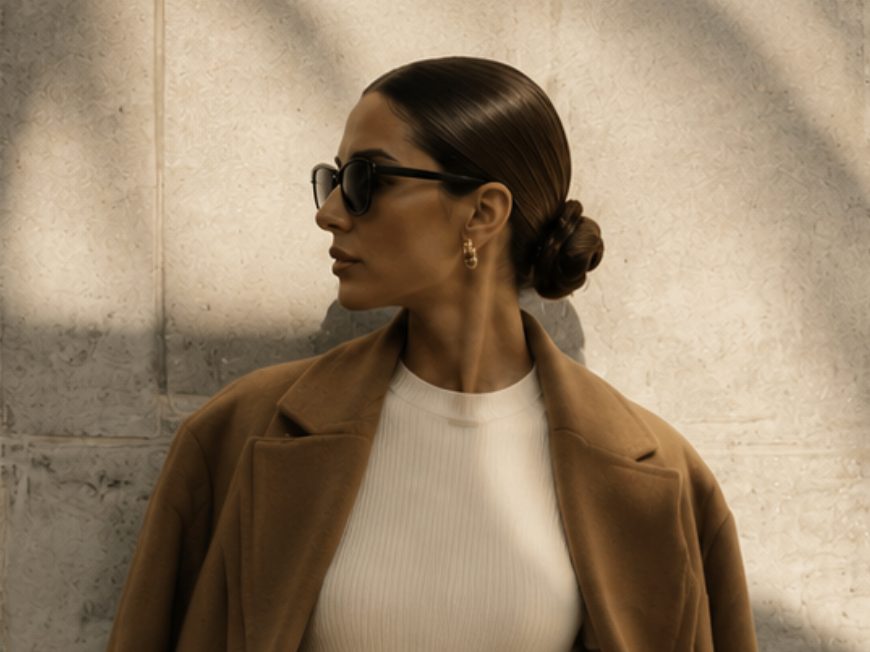
You do not need trends. You need things that feel expensive to the touch, even if they weren't expensive to buy — a wool coat instead of a synthetic one, a real cotton shirt instead of a poly blend. The eye reads quality before it reads brand name, and so does the hand when someone shakes it.
"Nobody has ever regretted being slightly overdressed for their own life."
A Word for the Skeptics
I can already hear the objection: isn't this just more pressure on women, another item on an already impossible list of things we're supposed to manage? I understand the instinct behind that question, and I want to take it seriously rather than wave it away.
Here's my honest answer: this is only pressure if it's imposed from outside, as one more standard to be judged against. It's something entirely different when it's chosen — when you decide, for yourself, that getting dressed on purpose is a small act of care you're extending to your own day. The difference between obligation and ritual is entirely a matter of who's holding the pen. Nobody is grading you. You get to decide what "dressing with intention" looks like for your own life, your own body, your own budget, your own season.
What I'd ask you to resist is the idea that not trying is somehow more free than trying. In my experience, the opposite has been true. The version of me who got dressed with real intention every day — not for anyone else, just for the simple discipline of it — was the version of me who felt most like herself. That's worth something. It might be worth more than we've been told.
The History Nobody Mentions
It's worth remembering that the idea of dressing with intention every day is not some new invention of quiet-luxury Pinterest boards. For most of human history, and in most cultures, what you wore was understood as a form of communication — not vanity, but information. It told people something about the occasion, about respect, about how seriously you took the room you were walking into. The shift toward radical, all-day comfort as the default is historically quite recent, and it's worth asking what got lost in that shift, alongside what was genuinely gained.
What was gained is real and shouldn't be dismissed: physical comfort, freedom from painful shoes and restrictive fabrics, permission to prioritize function. Nobody sensible wants to go back to girdles and pantyhose as a daily requirement. But somewhere between "we no longer have to suffer for appearance" and "appearance no longer matters at all," an entire generation slid further than it perhaps meant to.
What Our Mothers and Grandmothers Understood
Ask an older woman in your life about getting dressed, and you'll often hear something that sounds almost old-fashioned now: the idea that how you present yourself is a form of respect — for the people you're seeing, yes, but primarily for yourself. Not performance. Not people-pleasing. Just an internal sense that showing up as your most gathered self was part of taking your own day seriously.
I think about my own grandmother, who wore lipstick to the grocery store well into her eighties, not because anyone required it of her, but because she said it made her feel like herself. That's not vanity. That's a woman who understood something about the relationship between how we present ourselves outwardly and how we feel about ourselves inwardly — a relationship that runs in both directions, not just one.
"My grandmother used to say that lipstick was cheaper than therapy and worked about as well on a bad day. She wasn't entirely joking."
The Faith Angle Nobody Talks About
There's a thread here that connects to something deeper than fashion advice, and it's worth naming directly. Scripture doesn't ask women to be plain, and it doesn't ask us to be vain either — it asks for something more interesting than either extreme: dignity. The idea that how we carry and present ourselves can be an act of stewardship rather than either indulgence or neglect. A woman who dresses with care isn't necessarily worshipping her appearance. She might simply be treating the body she's been given as something worth caring for, the same way she'd care for a home she intends to keep for a long time.
This reframing matters because it takes the conversation out of the realm of "who are you trying to impress" and into something closer to stewardship — the same impulse that has you making your bed in the morning or keeping a tidy kitchen. Not because anyone's watching. Because it's a small, consistent way of honoring the life you've been given.
A Practical Month-Long Experiment
If any of this resonates, here is a genuinely simple way to test it rather than just thinking about it. For thirty days, commit to getting dressed with intention every single day, including the days with nowhere to be. Not elaborate. Not expensive. Just: real clothes, chosen on purpose, every day, even for the days that are technically "just" errands and school pickup and grocery runs.
Track how you feel, not how you look. Notice whether your posture changes. Notice whether you're quicker to make eye contact with strangers, quicker to strike up conversation, more willing to be seen. Most women who try this report the same thing: a subtle but real shift in how they carry themselves through an ordinary day, disproportionate to how small the actual wardrobe change was.
Week one: notice the resistance
The first few days will feel like more effort than they're worth. That resistance is data, not a signal to stop. It tells you how automatic the "default to comfort" pattern had become.
Week two: build the uniform
By now you'll start noticing which two or three outfit formulas you keep reaching for. Lean into them. This is the uniform forming, and it will make the rest of the month, and the rest of your life, considerably easier.
Weeks three and four: notice what changes around you
This is the part women report most often and expect least: other people start responding differently. Not because you're dressed up in some obvious way, but because something in how you carry yourself shifts, and people respond to that shift whether or not they can name what changed.
The Bottom Line
None of this is about becoming someone else, or performing a version of femininity that doesn't feel like you. It's about noticing that a small, repeatable, low-cost daily ritual — the fifteen minutes it takes to get dressed on purpose — has more influence over how a day unfolds than we tend to give it credit for. You don't need a new wardrobe. You need a decision, renewed each morning, that your own presence in your own life is worth showing up for.
What to Do With a Closet That Isn't Ready for This
Most women reading this will look at their actual closet and feel a little defeated before they've even started — too much fast fashion bought in a hurry, not enough of the quiet, well-made basics this whole idea depends on. That's a completely reasonable place to start from, and it doesn't require an expensive overhaul to fix.
Start with one category at a time. Replace the t-shirts first, since they touch everything. Find one good blazer that fits properly, even secondhand, before worrying about anything else. The goal isn't a finished wardrobe by next week. It's a slow, deliberate upgrade of the pieces you reach for most, so that "dressing with intention" eventually requires no thought at all — just a closet full of things that already work.